


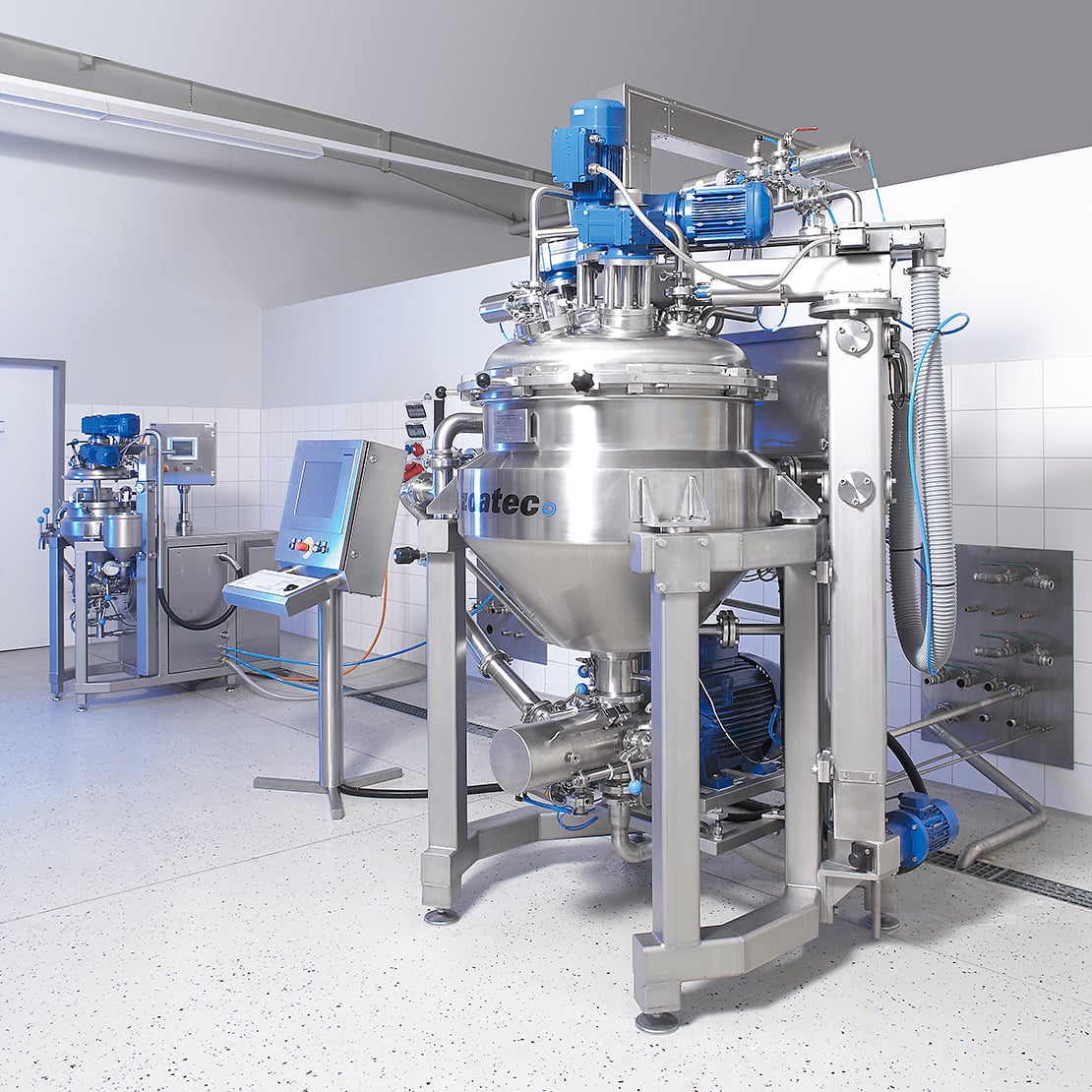
Run a rotor-stator homogenizer hard enough to break an emulsion down to a fine, stable droplet size, and you'll break almost anything else that passes through it, too. That's the paradox sitting at the center of most liquid and semi-solid processing: the same shear that makes a product smooth and stable is exactly what a formulation can't afford once fruit pieces, exfoliating particles, or other inclusions enter the recipe.
Key Takeaways
- The zoatec® BG homogenizer combines high-shear dispersing and low-shear pumping within the same unit.
- Its pneumatically controlled bypass allows delicate or chunky ingredients to avoid the approximately 1 mm shear gap.
- Product flows away from the motor and mechanical seal, reducing stress on the seal and extending its service life.
- Its modular frame, vessel options, and process testing allow the system to be configured for different products, batch sizes, and production requirements.
AZO Liquids built the zoatec® BG batch vacuum processing plant to get past that trade-off. Its homogenizer is patented specifically to disperse and protect delicate or chunky ingredients within the same unit, so a plant doesn't need a second machine just to handle the parts of a formulation that are supposed to stay intact.
Where Conventional Batch Homogenizing Falls Short
- Standard rotor-stator homogenizers run one way: high shear, all the time. Chunky ingredients — fruit pieces, seeds, abrasive pigments — either can't fit through the shear gap or get pulverized passing through it, so plants often end up running a second, dedicated homogenizer just for products with inclusions.
- In many conventional designs, product flow is directed toward the motor and mechanical seal. That flow path accelerates seal wear and shortens service life, making it one of the more common maintenance costs on a batch mixing line.
- Fixed frame and vessel designs lock a plant into one geometry. Moving to a different batch size or vessel shape later often means a rebuild instead of a swap.
- Manual disassembly for cleaning between batches adds hours of downtime, particularly in hygienic or GMP environments where full teardown is otherwise the default.
AZO Liquids designed the zoatec® BG's homogenizer and frame to answer each of these directly.
zoatec® BG vs. Conventional Homogenizing Systems
|
Feature |
zoatec® BG |
Conventional systems |
|---|---|---|
|
Chunky-ingredient handling in the same homogenizer |
✔️ |
✗ — requires a separate, dedicated unit |
|
Product flow directed away from the motor seal |
✔️ |
✗ — flow directed toward the seal |
|
Frame designed for full component access |
✔️ (honeycomb-style frame) |
✗ — platform-style frames limit access |
|
Lid design that keeps drips inside the vessel |
✔️ (vertical-lift lid) |
✗ — swivel-arm lids can drip product outside the vessel |
Mechanism: A Homogenizer With Two Modes
Inside the homogenizer, product is forced through a narrow shear gap, about 1 mm between a stationary stator and a rotor spinning at up to 3,600 RPM. That's standard dispersing mode, and it's what breaks an emulsion or suspension down to a fine, stable droplet size.
The patent covers what happens next. The stator is mounted so it can be pneumatically displaced mid-batch, opening a bypass that switches the same unit into a low-shear pump mode. Chunky ingredients pass through that bypass without ever crossing the shear gap, so a plant that needs to fold in fruit pieces, spices, or coarse pigments doesn't need a second machine to do it — and doesn't have to choose between fine dispersion and product integrity within a single batch.
Pump mode does double duty. Because it moves product at a high rate without shearing it, it also discharges large batch volumes faster than a passive drain, and on smaller BG sizes it can supply CIP water directly, without an auxiliary pump or extra pipework.
The homogenizer's throughflow direction is also built opposite the industry norm: product moves away from the motor and mechanical seal rather than toward it. That keeps the seal under less stress, extends its service life, and is a large part of why the unit is designed to be inspected and demounted from the front rather than pulled from the frame.
Modular by Design
The rest of the plant follows the same principle: match the configuration to the product, not the other way around. Process and supply modules separate, so utilities — pumps, controls — sit outside the clean room while the vessel and homogenizer stay inside it, avoiding a disturbance source on the load cells and simplifying compliance, sterile, or other special guidelines. The frame uses a comb design on four legs with load cells, so it accepts any vessel geometry — conical 80°, conical 130°, or domed bottom — without a rebuild, and the same frame geometry carries through the whole size range, which makes scale-up more predictable.
Agitator combinations range from one fixed to two mobile flow breakers, with a dissolver or jet-stream homogenizer available as additional mixing elements — each combination chosen to match heat exchange, discharge of residual quantities, and batch time to the specific product.
What Products Can the zoatec® BG Process?
The dual-mode homogenizer is especially valuable for formulations that require both fine dispersion and the controlled addition of ingredients that should remain intact.
Potential applications include:
- Emulsions and suspensions requiring a fine, stable droplet size
- Fruit-based products containing pieces or seeds
- Foods containing spices or other visible inclusions
- Personal care products containing exfoliating particles
- Formulations containing coarse pigments
- Liquid and semi-solid products requiring controlled mixing under vacuum
The system can first perform the high-shear processing needed to establish the product's consistency and stability. It can then switch to low-shear pump mode when delicate, chunky, or coarse ingredients are introduced.
Scale-Up Isn't Linear
Moving a formulation from a lab-scale BG10 to a production-scale BG3000 isn't a matter of running the same settings for longer. Rotor speed has to come down on larger machines to hold shear velocity constant at the rotor's edge. Run a big batch at lab-scale RPM and the product takes more damage, not less. Larger batches also heat more slowly but hold heat longer, which risks thermal overshoot unless the system has active cooling through a heat exchanger. And abrasive products — ketchup is a common example — wear rotor and stator geometry over time unless the parts are specified in the right material from the start.
That's the kind of tuning AZO Liquids' Customer Process Center is built for: testing with the customer's own product, product analysis, and scale-up calculations before a plant is specified, so the numbers on paper hold up on the production floor.
Contact AZO Liquids
Fine dispersion on one side. Intact ingredients on the other. That trade-off doesn't have to define a plant's process. AZO Liquids designed around it. Contact AZO Liquids if your formulation still forces that choice. Let's talk about your process.
Frequently Asked Questions
How does the zoatec® BG protect chunky ingredients during homogenizing?
The zoatec® BG protects chunky and delicate ingredients by pneumatically displacing the stator to open a low-shear bypass. Ingredients can then pass through the homogenizer without crossing the approximately 1 mm rotor-stator shear gap that would otherwise break them apart.
Can the zoatec® BG homogenize and pump product in the same unit?
Yes. The homogenizer operates in a high-shear mode for creating fine emulsions and suspensions and a low-shear pump mode for circulating or discharging product. This allows both functions to be performed within the same processing unit.
Does the zoatec® BG require a second homogenizer for products with inclusions?
No. The dual-mode design allows the zoatec® BG to disperse a product and subsequently incorporate chunky or delicate ingredients within the same unit, eliminating the need for a separate homogenizer dedicated to products containing inclusions.
Related Blog Posts
Manufacturers across industries are balancing new opportunities with growing complexity as technology, market demand and evolving
Walk the batching area of a typical processing plant and you may see the same chain repeated: a silo feeding a screw conveyor, feeding a