


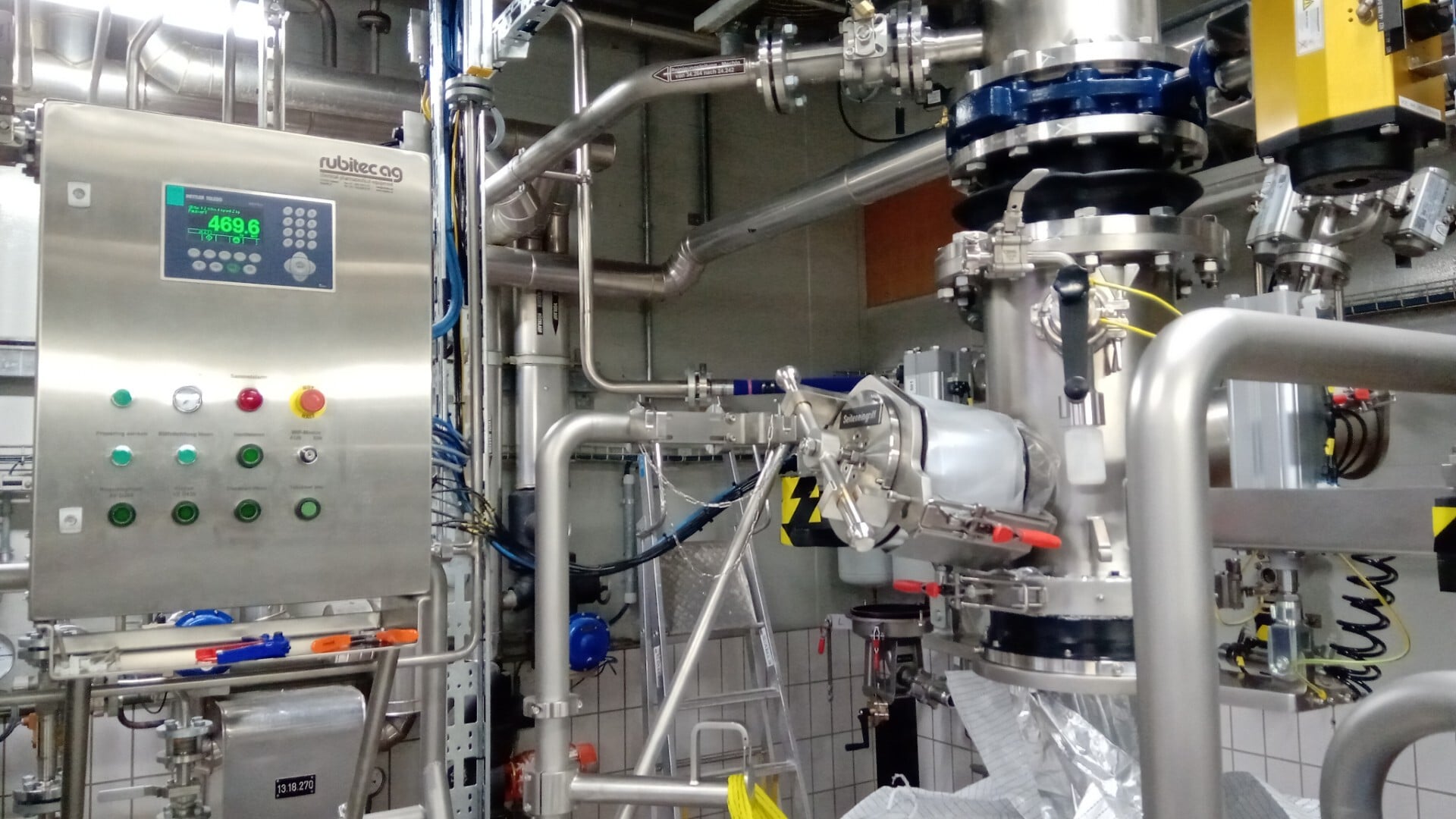
Contained bulk bag unloading depends on what happens at the connection point. The bulk bag itself is rarely the hardest part of a pharmaceutical powder-handling process. The real risk appears at the connection point. That brief moment when an operator opens, positions, and docks the bag spout can determine whether potent powder stays inside the process or escapes into the room.
Adding seals, losing components, high exhaust-air demand, or a complicated changeover sequence, and a simple material-transfer step becomes a recurring operational problem.
Key Takeaways
- SmartDock® creates containment by forming a tight physical seal before powder transfer begins.
- The system reduces reliance on high-volume exhaust air and eliminates loose O-rings in the product area.
- A mechanical clamp maintains containment during compressed air or power loss.
- SmartDock® supports OEB 4 applications today and can be adapted for future OEB 5 requirements.
A leading pharma manufacturer faced exactly that challenge while planning a new process for unloading potent powders from bulk bags. The system needed to meet OEB 4 containment requirements, protect operators during routine bag changes, and remain practical enough for daily production.
The SmartDock® was selected because it approached containment differently: create a tight physical connection first, instead of using a large exhaust system to compensate for an imperfect seal.
How SmartDock® Improves Powder Containment
Many powder-unloading systems depend heavily on suction air to pull airborne dust away from the docking point. That can require larger fans, more ductwork, additional filtration, and greater utility demand. Three sealing lines create a controlled connection between the bulk bag and the receiving process. Because containment begins with a tight physical interface, the installation does not depend on a high-volume exhaust fan to compensate for leakage.
That distinction mattered for the pharma manufacturer. The goal was not merely to capture dust after it escaped. It was to prevent the escape from happening in the first place.
The result is a more focused containment strategy with less exhaust-air demand and fewer supporting components. For facilities where mechanical space, utility capacity, and cleaning requirements already compete for attention, removing unnecessary complexity can be just as valuable as improving containment performance.
Simplifying Contained Bulk Bag Changeovers
A containment system can perform well in testing and still create problems if operators find it difficult to use. Every extra fold, loose seal, or awkward movement introduces another opportunity for variation. Multiply that by repeated bag changes across multiple shifts, and a small usability issue becomes a production issue.
SmartDock’s docking sequence is designed to be quick and repeatable. A trained operator can complete the central connection step in roughly 50 seconds. The bag spout is secured through the sealing system without the complicated folding patterns associated with some older docking methods.
There are also no loose, disposable O-rings that must be inserted or removed through the product area. Traditional double O-ring systems can create an uncomfortable combination of contamination risk and operator frustration. The seal must be handled correctly every time, and the component itself can come into contact with the product stream or, in the worst case, fall into it. With the docking system, we remove that failure point.
Maintaining Powder Containment During Utility Failures
Containment should not disappear with the utilities. A mechanical clamp keeps the connection secured even if compressed air or electrical power is lost. Production may stop, but containment remains intact while the facility responds. The process may stop, but the connection remains mechanically secured.
That matters because operators working near a closed containment system may not be wearing the level of personal protective equipment required for an open powder-handling task. A sudden utility failure should not instantly turn a controlled process into an exposure event.
The mechanical clamp gives the facility time to respond. Maintenance can restore the system, assess the condition, and follow the appropriate recovery procedure without the docking point immediately opening or releasing powder. It is a simple design principle with a significant operational consequence: a failed utility does not have to mean failed containment.
The Empty Bag Is Still Part of the Containment Problem
Empty does not always mean clean. After discharge, residual powder may remain inside the bulk bag or around the outlet spout. Pulling the bag away without controlling that residue can release dust precisely when the operator is closest to the connection.
SmartDock® addresses the entire changeover, not just the initial docking.
The empty bag is first evacuated through an integrated H13 or H14 filter. This reduces its volume, limits trapped airborne powder, and makes the bag easier to handle and dispose of.
The spout is then sealed in two places using strong, readily available cable ties and cut between them. The empty bag can be removed, while the sealed section of the previous spout remains attached to the docking interface.
That retained spout keeps the process closed until the next bulk bag is connected. Instead of exposing the flange between bags, the system carries containment through the full changeover sequence.
OEB 4 Today Does Not Have to Limit Tomorrow
The manufacturer’s current application required OEB 4 containment, generally associated with occupational exposure levels below 10 micrograms per cubic meter. But pharmaceutical product requirements do not stand still.
A facility may later add a more potent active ingredient, change a formulation, or introduce a product with a significantly lower exposure limit. Replacing an entire docking system to accommodate that change would be disruptive, especially once the process has been installed, qualified, and integrated into production.
An OEB 4 installation does not lock the facility into its original containment level. If future products require OEB 5 performance, the existing equipment can be adapted with an additional spring-loaded press ring rather than replaced. The operating procedure changes slightly, but the core technology and operator interface remain familiar. Facilities that anticipate future high-potency applications can also prepare the controls in advance, making the transition easier when process requirements change.
That gives manufacturers an option that is often missing from containment equipment: the ability to adapt the system instead of replacing it.
The Same Connection Principle, Reversed
Although unloading is the more common application, the same containment approach can also support bulk bag filling. In pharmaceutical production, this is often relevant when powder must move between process steps. A lined bulk bag can serve as a single-use intermediate container, avoiding the washing, drying, and cross-contamination controls associated with reusable rigid containers.
The filling station requires additional controls, including software, dosing functionality, and process instrumentation. It is not simply an unloading station turned upside down. But the containment principle remains the same: create a secure, controlled connection before powder begins to move.
Using a common docking equipment across unloading stations, filling systems, and glove box applications also simplifies operator training. Once personnel understand the connection process, they can apply the same basic procedure across multiple contained transfer points.
Why Manufacturers Choose SmartDock®
For the leading pharma manufacturer, the solution addressed more than a dust-control problem. It reduced reliance on high-volume extraction, removed loose seals from the product area, maintained containment during utility loss, simplified bag changes, and preserved a path from OEB 4 to OEB 5 as future products require greater protection.
|
Conventional Docking |
SmartDock® |
|
Relies heavily on exhaust air |
Creates a physical seal first |
|
Loose O-rings may be required |
No loose O-rings in the product area |
|
More supporting components |
Reduced exhaust-air demand |
|
Containment may depend on utilities |
Mechanical clamp maintains containment during utility loss |
|
Limited future flexibility |
Can be adapted from OEB 4 to OEB 5 |
The most effective containment systems are not the ones that make a process feel more complicated. They are the ones that make safe operation easier to repeat.
Planning a contained bulk bag unloading or filling application? Talk with AZO about how rubitec’s SmartDock® can be configured around your process, containment requirements, and future production needs.
SmartDock® Containment FAQs
FAQ: How does SmartDock® improve powder containment during bulk bag unloading?
SmartDock® creates three sealing lines between the bulk bag and receiving process before powder begins to flow. This reduces reliance on high-volume exhaust air by preventing powder from escaping at the connection point.
FAQ: What happens if compressed air or electrical power is lost?
A mechanical clamp keeps the docking connection securely closed during a utility failure. This maintains containment while the facility restores the system and follows the appropriate recovery procedure.
FAQ: Can SmartDock® support future containment requirements?
Yes. An OEB 4 installation can be adapted for OEB 5 applications by adding a spring-loaded press ring rather than replacing the entire docking system.
