


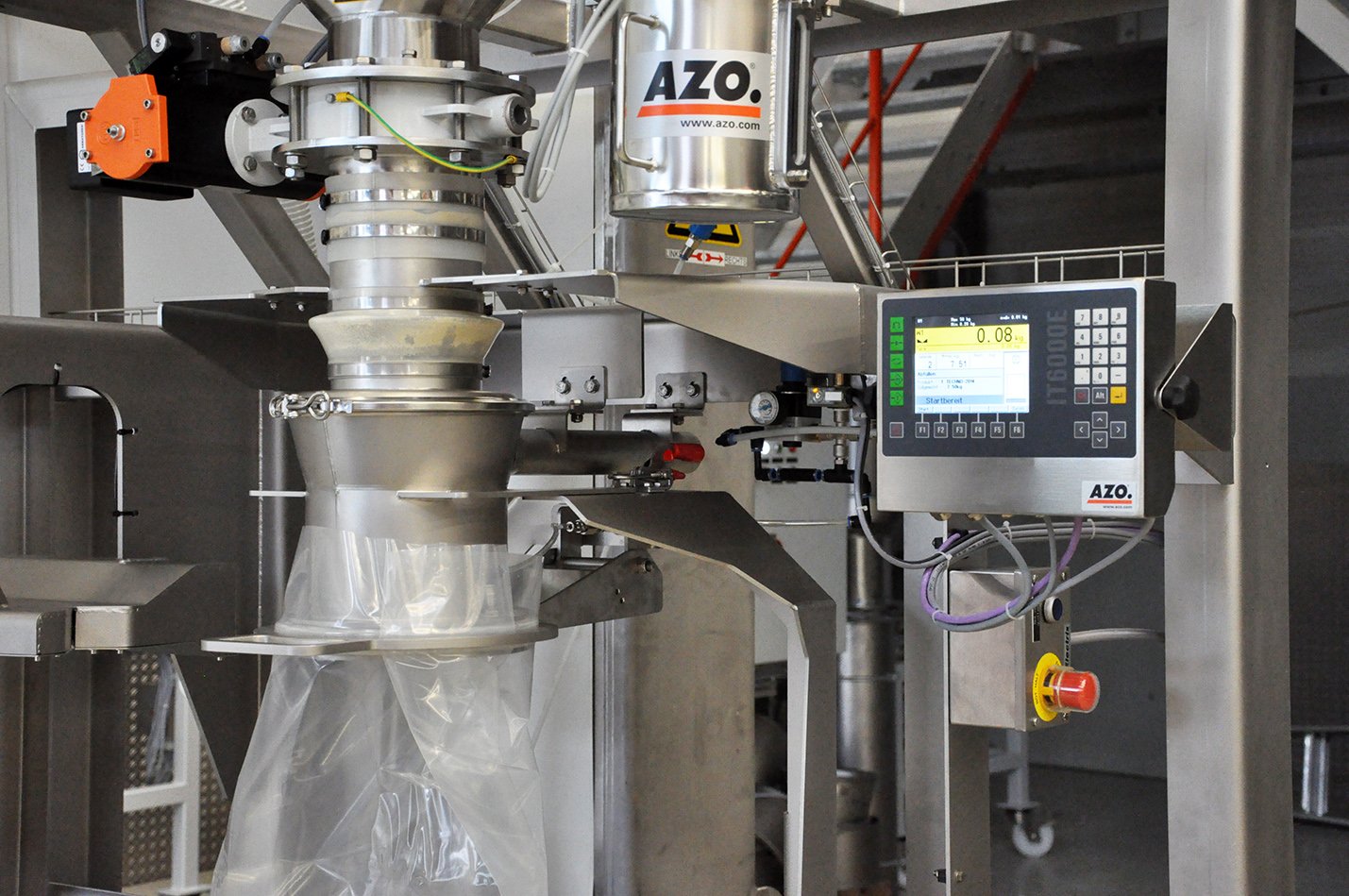
Small-container filling is one of those processes that looks straightforward, until the realities of powders, tight tolerances, and frequent changeovers show up, especially in small batch powder packaging.
If you are producing bulk solids in relatively small batches, the packaging step has to do more than move product into a container. It has to support consistent dosing and weighing, protect quality at the final step before dispatch, and adapt to different container types without turning every changeover into a maintenance event.
That is the operating context for our filling and weighing station, a compact powder filling station designed around flexibility and accuracy. The design assumes that high fill rates are not always the priority in small-batch production. What matters more is a compact, versatile system that can be configured to match real packaging requirements.
Why small-container filling gets complicated fast
A typical shift rarely involves one “standard” container.
You may be filling sacks, then boxes with inner liners, then rigid receptacles like tubs or small drums. Each format change affects docking, dust control, dosing behavior, and how quickly the station can be cleaned and retooled. When these details are not engineered into the station, the consequences are predictable. Changeovers take longer than planned. Docking becomes inconsistent. Dust and cleanup effort increase. The packaging area becomes the constraint, even when upstream mixing and conveying are running smoothly.
A flexible filling station does not solve this by adding complexity. It solves it by keeping the critical steps stable, dosing, screening where needed, and gravimetric filling, while swapping the parts that must change with the container.
What a flexible station needs to handle
For small-batch specialty filling, the requirements tend to be practical and repeatable:
- A configuration that supports small to medium filling capacities.
- Modular design so the station can be configured and upgraded based on the application.
- Rapid retooling to accommodate different receptacles.
- A weighing device that can be calibrated, with scales in the 10 to 50 kg weighing range.
In other words, flexibility has to be built into the system from the start. It cannot be an afterthought.
How the station fits into a process line
Placement and feeding are often driven by the plant layout and the material flow upstream. The station can be positioned directly under mixers or buffer hoppers, or it can be fed from containers and big bags.
Dosing and screening choices
From there, dosing can be performed using either a dosing screw or a cyclone screener type DA. The cyclone screener approach is designed for combining dosing, control screening, and filling in one system. It supports elimination of foreign particles and breaks up agglomerates as far as possible prior to filling, supporting control screening for powder filling.
If the products being filled have already been screened, dosing can also be performed using a dosing screw with a vibration bottom.
Metal detection can be included as a module, and additional protection against super-fine metallic impurities can be achieved using a sensitive pick-up coil below the screener.
Manual where it makes sense, automatic where it matters
Not every receptacle type benefits from full automation, especially when flexibility and frequent changeovers are the priority.
For sacks or boxes with inliners, handling at the station is carried out manually. The operator docks the receptacle at the filling head and starts the dosing process using a foot-operated switch. Dosing then runs automatically until the specified fill weight has been obtained, and the receptacle can be disconnected using the foot-operated switch again.
For rigid receptacles like tubs and small drums, the system can also be designed for fully automatic operation.
Docking and dust control start at the filling head
In powder filling, the container interface is not a detail. It is where dust control and repeatability are won or lost, and where containment and operator exposure are managed in practice. For rigid receptacles, a dust-tight connection is created between the filling head and the receptacle using an elastic sealing surface that exerts pressure on the receptacle. Custom-fit filling heads can be supplied for different-sized receptacles, and receptacles can be fed manually or, as an option, automatically.
For flexible receptacles, different head concepts are available. With an inflatable ring for inliners, sacks, and pouches, the receptacle is pulled over the ring by hand, clamped, then the ring is inflated to create a dust-tight connection. Different-sized receptacles can be docked with this approach. With an inflatable collar for sacks and pouches, the receptacle is pulled over the non-pressurized collar, then the collar is inflated to create a dust-tight connection. In this case, the receptacle and inflatable collar must match in terms of size.
The system can also be connected to an aspiration unit in order to vent displaced dust-laden air during filling. As the target weight approaches, dosing is switched from coarse to dribble feeding to achieve greater accuracy.
Sealing options that match the receptacle
The sealing step is often where small-batch operations lose time, especially when packaging formats vary.
Stationary or manually operated sewing machines can be used to close flexible receptacles. Bonding equipment is available for sealing pouches, inliners, and plastic sacks made of weldable materials. It is also possible to combine sealing methods, for example by bonding the inliner first and then sewing the outer sack shut.
Weighing, tolerances, and realistic performance expectations
Gravimetric filling is only useful if it stays consistent across products with different flow behavior. The station supports weights and measures approved scales in the 10 to 50 kg weighing range, and the weighing device can be calibrated. Where products are filled into retail receptacles, permissible calibration tolerances must be adhered to according to weights and measures regulations. Realistic variances in the range from 20 to 50 g are possible, depending on the flow properties of the products being filled.
If there is no provision for control or correction weighing, the system can be designed as an automatic scale for official calibration tests. Throughput is application-dependent. Depending on receptacle form and size, and on the number of operators, it is possible to fill and seal the receptacle in 1 to 2 minutes. A standard throughput rate for the system is 1 receptacle per minute.
Changeover is only flexible if it is fast. Modularity matters only if it reduces downtime. The station includes a range of filling heads for common receptacle forms and sizes, and the heads are designed to be easy to exchange without tools. This makes it possible to change receptacles over in 2 minutes.
Controls and integration, standalone or connected
Walk into two different packaging rooms and you will see why controls can never be one size fits all.
In the first room, the priority is simple: run the next container, hit the target weight, move on. The operator sets and maintains the filling and weighing parameters right at the operating unit, and the station runs the weighing process as a self-contained step on the line.
In the second room, the packaging station is not an island. Batch data has to flow upstream and downstream, recipes are managed in a higher level system, and weighing becomes part of a broader control and reporting chain. In that setup, filling and weighing parameters can be sent to a master control system. In an upgrade stage, the weighing function is performed by the weighing controller, data management sits in a master system such as MES or PPS, and the power units for the dosing drives can be housed in a central switch cabinet.
Now add the reality many sites live with. If the filling area is a hazardous, classified location due to flammable vapors or combustible dust, the controls scope includes electrical classification and documentation. OSHA’s hazardous location rule addresses electrical equipment and wiring in hazardous, classified locations, and it notes that NFPA 70, the National Electrical Code, defines hazardous gases, vapors, and dusts by groups, with equipment marked for the class and group for which it is approved.
Behind the courtain, the station is built around a compact control unit that manages parameters and the weighing process. When projects require it, additional custom functions can be implemented through a limited number of inputs and outputs, and load modules for dosing and related equipment can be installed in a separate switch cabinet that can be located at the station or set away from it. Finally, because packaging is the last touchpoint before dispatch, cleanability matters. The filling unit, including accessories, is designed to satisfy stringent hygiene requirements, and bespoke solutions are available for complete inline wet cleaning.
Next Step
If this sounds like your packaging reality, make the next step concrete.
- List your containers, fill weights, and changeover cadence. Include any liners, dust control expectations, and whether you need manual or automatic handling for each format.
- Match those inputs to a station configuration. Choose the dosing method, filling head style, sealing approach, and whether you want stand-alone operation or integration into a master control system.
- Bring the list to a short technical scoping call, focused on your powder filling station requirements. We will use it to confirm what fits, what needs a custom approach, and what information is still missing before you commit to a layout.
Related Blog Posts
If you aren’t performing maintenance regularly on your equipment, this story is a good reason to start.
From AI-powered maintenance and domestic manufacturing investments to ingredient innovation and evolving trade policies, manufacturers are