


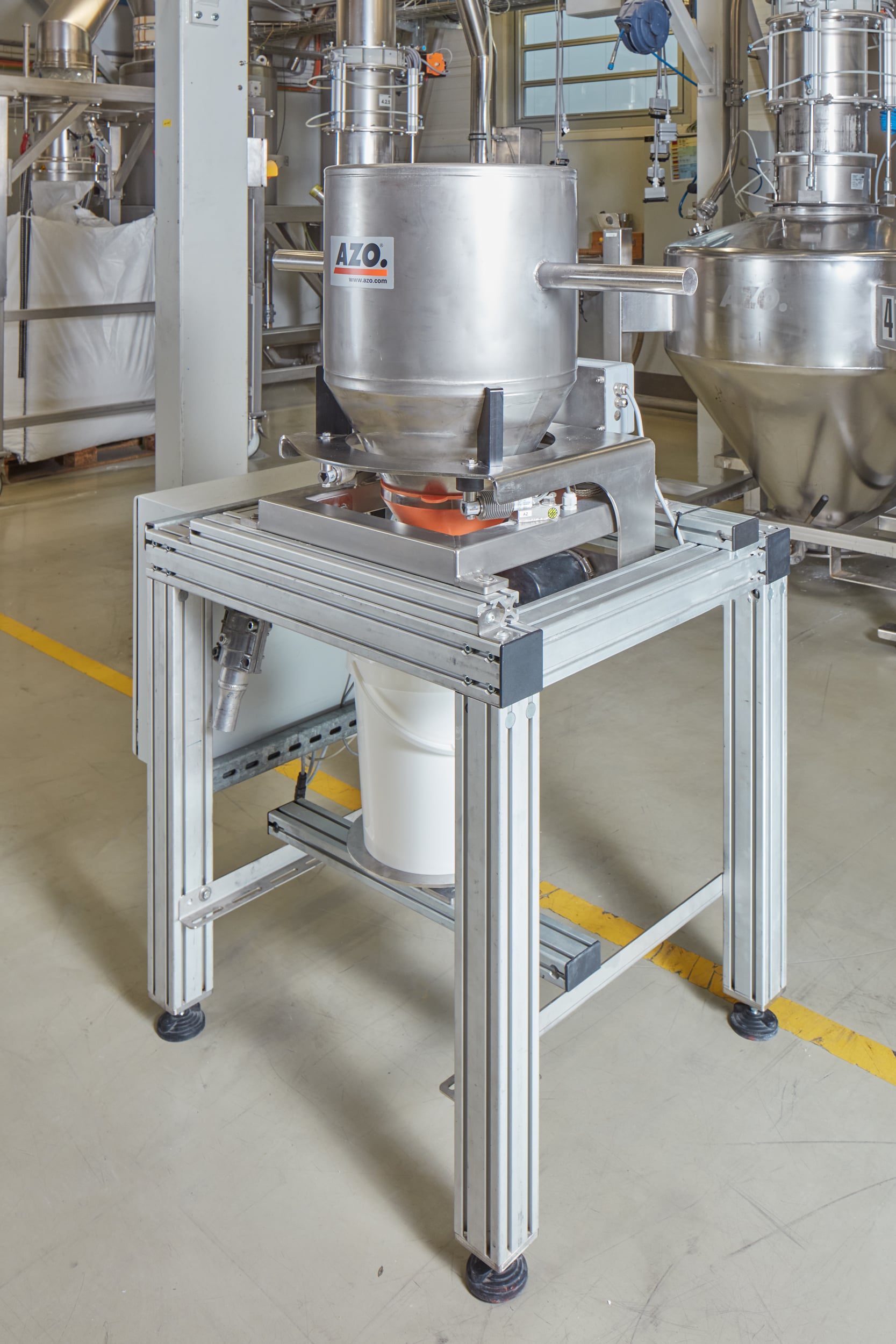
Manual ingredient dosing increases labor costs, material loss, batch variability, dust exposure, and the risk of costly formulation errors. Manufacturers are adding more minor ingredients to formulations, often at smaller percentages and with tighter quality expectations. The ingredients may be small by weight, but they directly affect batch consistency, product performance, and cost.
Key Takeaways
- Manual ingredient dosing can increase labor costs, material loss, and batch variability.
- Managing multiple recipes with small additions can become difficult with manual processes.
- The eDos ingredient dosing system achieves accuracy as precise as ±1 gram for many materials.
- eDos is designed for controlled dosing of nano, ultra-fine, and minor ingredients.
At low volume, manual weighing and kitting can handle the job. An operator weighs several small ingredients into containers, stages them for a batch, then transfers them into a process vessel. That workflow depends on operator technique, labeling, sequence control, and repeatability across shifts. When the recipe count grows, ingredient values increase, or the material itself becomes harder to dose, manual handling starts to create problems.
Why Manufacturers Are Replacing Manual Ingredient Dosing
- Too much labor tied up in weighing and kitting
- High-value ingredients lost during weighing, transfer, or cleanup
- Batch inconsistency from manual variation
- Dust release during handling of fine powders
- Difficulty managing many recipes with small additions
- Operator exposure concerns with sensitive or hazardous powders
Any one of these can justify a closer look at the dosing step. When several apply at once, the case for automating minor ingredient dosing gets hard to ignore.
How the eDos Ingredient System Achieves ±1g Accuracy
The eDos dosing unit uses a flexible polyurethane (PU) dosing funnel, a dosing lip, and a spring element. A servo-electric actuator applies targeted pressure to the dosing lip, opening a defined gap. Material flows through that gap into the target vessel or scale. When the actuator releases, the spring element closes the opening.
No rotating parts contact the raw material. That means no metal abrasion, which matters in any application where contamination from wear parts is a concern. The polyurethane construction also provides high abrasion resistance with abrasive materials like quartz sand or titanium dioxide.
Rather than relying on a single discharge setting, eDos approaches the target weight in stages. The system can use coarse, fine, and extra-fine dosing modes, progressively reducing the gap opening and actuator oscillation as the weight on the scale approaches the setpoint. The standard version achieves batch dosing accuracy of ±1 gram, with a dosing capacity range of 5 to 170 gallons per hour. That 1:32.5 range is significantly wider than conventional dosing screws, which typically cover a much narrower band at lower accuracy.
When Powder Dosing Accuracy Depends on Flow
Accuracy is only part of the problem. Fine powders can bridge in the funnel, stick to the hopper wall, or discharge in pulses. If the material does not reach the scale in a stable flow, dosing time increases and the weight reading becomes unreliable.
For difficult-flowing materials, eDos supports an optional pneumatic knocker. The knocker acts on the dosing funnel to break up deposits and reduce bridging, keeping material moving through the dosing point.
Dust is a related issue. Even when the total ingredient quantity is small, nano, ultra-fine, and micro powders can release dust that affects housekeeping, weighing reliability, and operator exposure. The eDos dosing station includes air extraction near the funnel outlet. A flat nozzle extracts dust from the side of the dosing area in the standard configuration. For powders that disperse more broadly during discharge, a ring suction setup captures dust around the full outlet perimeter.
Tested Accuracy Across Materials
AZO has run dosing trials on the stand-alone station across a range of materials. Results vary by powder behavior, but the tested figures give a useful reference:
|
Material |
Dosing accuracy |
|
White sugar |
± 1 g |
|
Quartz sand |
± 1 g |
|
Citric acid |
± 1 g |
|
Maltodextrin |
± 2 g |
|
Calcined kaolin |
± 2 g |
|
Pearl soot |
± 2 g |
|
Wheat flour |
± 3 g |
|
Lactose |
± 3 g |
|
Titanium dioxide |
± 3 g |
Achievable accuracy depends on scale resolution, tare weight, vibration, settling time, and the flow characteristics of the raw material. A dosing trial should confirm how the specific material behaves in the equipment before finalizing a system design.
Where eDos Fits
eDos is designed for controlled dosing of nano, ultra-fine, and minor ingredients where accuracy, cleanliness, and repeatability matter more than bulk throughput. The strongest fit is in industries working with higher-value ingredients, complex formulations, and tighter process expectations.
Pharmaceutical and nutraceutical: APIs, excipients, vitamins, and health-focused additives where dosing errors affect batch documentation and regulatory compliance.
Specialty chemical: Pigments, fillers, and functional additives that require gram-level accuracy in formulations.
Plastics: Masterbatch additives, colorants, and stabilizers dosed into compounding or extrusion processes.
Food and beverage: Colors, flavors, and powdered additives in applications where the ingredient value or accuracy requirement justifies a more controlled approach than bulk feeding.
The dosing unit is available in food-approved or silicone-free versions to meet product-contact requirements across these industries. eDos is not intended to replace feeders handling large-volume commodity ingredients or materials that cannot be conditioned to flow through the dosing funnel.
Three Ways to Deploy: Stand-Alone, Batching System, or Robotic Dosing
Stand-alone station. For focused dosing tasks, smaller ingredient sets, or specialty production. The compact design and precise control make it suited for autonomous operation.
AZO COMPONENTER® integration. In this configuration, a linearly movable scale travels to different feeding points according to the recipe. The actuator rides on the scale, so a single actuator serves multiple eDos dosing stations. Because the actuator is the most expensive component, this architecture pays for itself faster as the number of stations increases. The COMPONENTER batching system supports automated recipe-controlled weighing with minimal manual handling.
AZO RoLog®. A robot-based system where a central robotic arm feeds individual dosing stations arranged in a circle. eDos serves as the dosing device at each station, enabling fully automated small-quantity dosing for complex recipes. Learn more about AZO RoLog.
Evaluate the Fit Before You Commit
Before selecting eDos, manufacturers should confirm the target dose, allowable tolerance, particle condition, moisture sensitivity, dust behavior, cleaning requirements, and whether the material is prone to bridging or compaction. These details determine whether eDos is the right dosing method for the application, and they cannot be assumed from a material name alone.
To evaluate whether eDos fits your ingredient and process layout, contact us.
Ingredient Dosing FAQs
FAQ: When should manufacturers automate minor ingredient dosing?
Manufacturers should consider automating minor ingredient dosing when manual weighing and kitting create labor inefficiencies, material loss, batch variability, or dust exposure. Automation may also help manufacturers manage multiple recipes with small additions.
FAQ: How accurate are automated ingredient dosing systems?
The AZO eDos system can achieve dosing accuracy as precise as ±1 gram for many materials. Actual accuracy depends on material flow characteristics, scale resolution, vibration, and process conditions.
FAQ: What ingredients are best suited for automated dosing systems?
Automated dosing systems are well suited for nano, ultra-fine, and minor ingredients where accuracy, cleanliness, and repeatability are critical. Common applications include pharmaceutical ingredients, specialty chemical additives, pigments, colorants, stabilizers, flavors, and powdered food additives.
Related Blog Posts
If you aren’t performing maintenance regularly on your equipment, this story is a good reason to start.
From AI-powered maintenance and domestic manufacturing investments to ingredient innovation and evolving trade policies, manufacturers are