


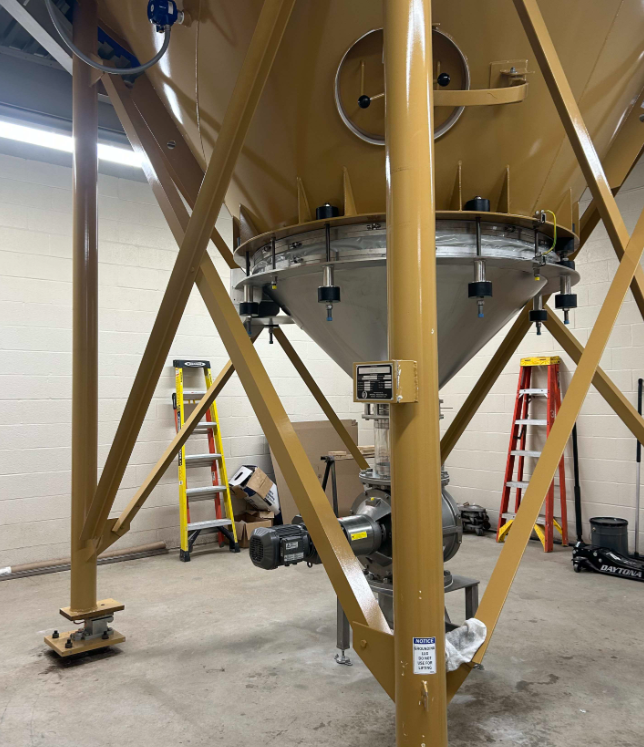
Managing silo inventory takes sensors. Which sensor you need depends on the question you're trying to answer. Do you need to know exactly how much product is sitting in the silo? Or do you just need to know when it's empty?Here's what each type of monitor tells you, and when to reach for it.
Myth #1 About Inventory Management
First, it’s important to clear something up: Point-level indicators are not true inventory management.
Point-level indication tells you whether a silo is full, empty, or at the halfway mark. A probe mounts to the silo wall, and when bulk solid materials cover the rod or the paddle, the paddle stops turning. Capacitive probes and tuning forks are two types of these devices. Mount one low to catch empty, one high to catch full, and another in between if you want it. But that's the full extent of the data. The probe reports only when material covers it.
Where these indicators fall short is when your inventory management relies on accurate silo readings. Before committing to a new rail car or truckload, you need to know a more accurate measurement of how much is left in the silo, and whether the delivery will fit when it arrives. If the delivery takes three days to get here, do you have three days of product left? Guess wrong and you're paying to hold a rail car you can't unload, or sending it back half full after paying for a full load.
For this scenario, it’s time to look at a different mode of measurement, like strain gauges, load cells and continuous level measuring.
Strain Gauges, Load Cells and Radar Probes
These three technologies have their pros and cons, so let’s break down each and when to use them based on your goals and budget.
Strain gauges only measure compression in the silo's leg.
A strain gauge is a simple load cell that reads microscopic compression in the wall or leg of the silo as weight bears down on the structure. It mounts to the leg and infers inventory from how much the metal gives.
That makes it sensitive to conditions that have nothing to do with how much product you have. Temperature changes how the metal reacts, so a hot day and a cold day give you different readings on the same material. Wind load does the same thing to outdoor silos.
Strain gauges aren't common, mostly because mounting one requires a silo to have legs. Most silos are big cylinders sitting on the ground. But strain gauges can also be retrofitted.
AZO recently added weight measurement to existing silos by mounting to the legs after the fact. Describe the scenario here and what it did for the customer in terms of results.
Load cells are the most accurate choice for inventory measurement.
Load cells measure the actual mass in the silo. It’s the same principle as a bathroom scale. How it works is three or four cells sit in the base and read the weight pressing down on them. The payoff is true accuracy. Load cells hold to a tenth of a percent, which is as close to a true number as inventory measurement gets. They also feed cleanly into an SAP inventory management system.
However, the cost runs five to 10 times that of a radar probe, and the installation comes with conditions:
- The silo has to be isolated and sitting on legs.
- It can't be tied to the ground.
- It can't have piping running into it.
About half of AZO's customers use load cells. The rest don't need to know exactly how much is in the silo and would rather not pay for the precision. That's where radar probes come in.
Continuous level measuring with radar probes delivers the best accuracy for less cost than load cells.
Between 60-70% of our customers are shifting to radar probes. The probes track how much is in the silo day to day and shift to shift, and operators can pull the number up on a screen.
Radar and ultrasonic probes give accurate inventory measurement without a true weight measurement. Dump a 40,000-pound truckload into your silo and the probe won't read 40,000 pounds. Instead, it measures distance to the material surface. Accuracy runs 1- 5%, compared with a tenth of a percent for load cells.
For most operations that's close enough, and it costs less than load cells. That’s why radar and ultrasonic probes are the most commonly used technology on this list.
Radar probes had a rough start. When they first hit the market in the early 2000s, dust threw off the readings badly enough that people wrote them off entirely and went back to load cells. Innovations over the last five years changed that. Higher frequencies and better software let the probe recognize the material's angle of repose and account for it. Readings still depend on consistent bulk density and moisture content.
Which Sensor To Choose?
When customers ask us which sensor to buy, we often ask them instead: What decision are you making with the data?
- If you want accurate inventory that doesn't rely on a true weight measurement, and you want to save on cost, use continuous level measuring probes.
- If you need true weight accuracy for ingredients, use load cells and plan for a more expensive price difference.
Measurement also gets designed alongside discharge and conveying. Vibrating bottoms, discharge aids, and flow behavior all change what a sensor sees, so the sensor choice can’t stand on its own. We take all of this into account when designing systems.
Most systems include a graphics package that puts the silo on a screen with a colored bar graph showing level, switchable to weight. That reading can connect to SAP or another product management system that tracks what's on hand and flags when it's time to reorder.
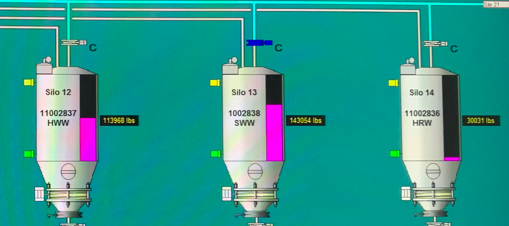
AZO has used different probe models over the years and we’ve standardized the ones that have held up the most. The radar probe we use now is the sweet spot: accurate enough for the decisions most operations are making, without the load cell price tag.
Contact us to talk through inventory measurement as part of your ingredient handling system.