


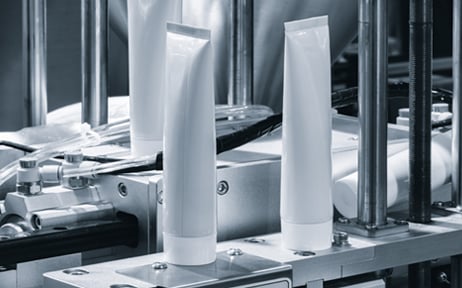
A global toothpaste manufacturer came to AZO with a powder problem that started at the receiving dock and followed the material all the way to the mixer.
Raw ingredients arrived at their Southeast U.S. facility in three formats: bulk bags, 25 kg bags, and 25 kg boxes. Each one made dust as it traveled, and each powder behaved differently once it came time to unload from a bin. On top of that, the weighing that tied the whole recipe together was still done by hand.
We strategically rebuilt the front end of that process from unloading through batch assembly to significantly improve dust control, weighing accuracy, and help the manufacturer create a consistent product batch after batch.
The Challenge
Every time a bag opens, powder goes somewhere it shouldn't.
In a plant running bulk bags alongside 25 kg bags and boxes, that adds up: particulate in the operators' breathing zone, product on the floor instead of in the batch, and a housekeeping crew spending its shift chasing the mess. Dust also costs yield. Material that ends up in a central collector is material the plant paid for and can't use.
Flow was the second problem. Toothpaste formulations pull from a wide range of powders. Some move freely, while others are cohesive enough to bridge across a bin outlet or rathole straight down the middle, leaving material packed against the walls. When discharge rates swing, so does everything fed from them.
The third problem was the weighing itself. Manual dispensing puts a person between the formulation and the batch, and people aren’t always consistent. Small deviations on a minor ingredient show up as batch-to-batch differences in the finished product, plus rework and scrapped material when a batch misses spec.
Plus, record-keeping that comes with manual weighing depends on the operator filling out the sheet. That's a thin position for a company making a product the FDA regulates as an over-the-counter drug. Fluoride toothpaste falls under OTC Monograph M021, which means batch documentation isn't optional.
The AZO Solution
We designed dust-free unloading and storage for all three incoming formats, then automated the weighing and batching behind it.
Bulk bag unloading built around discharge, not just docking. The bulk bag unloading stations were equipped with bag massagers, vibration devices, flow-promoting hoppers, and controlled outlet interfaces. Everything we needed to fully empty the bag because residual material left clinging inside a bulk bag is a loss, and can require an operator to work the bag by hand, something we needed to avoid.
Bag dump stations that screen and capture at the same time. Ingredients arriving in bags and boxes go through bag dump stations fitted with integral vibrating screens, which break up agglomerates before they reach the process. Each station got its own dust collection filter to prevent product loss to the central system, enhancing operator safety by keeping the air around them clean.
A linear COMPONENTER® that walks the batch through the recipe. A batch container, or batchtainer, travels a line of raw material dispensing stations and collects the ingredients for that recipe. The layout keeps material flow simple, minimizes the equipment footprint, and reduces batch cycle time. It also leaves room to add stations later as the formulation list grows.
Automated weighing in place of scoops and clipboards. Automated dispensing and weight verification hold each ingredient inside its tolerance and write an electronic record at the same time. Traceability stopped being a separate task someone performs after the fact.
Implementation
The project ran about two years end to end. Equipment design and fabrication took 8 to 10 months. Installation, commissioning, and site acceptance testing took another 10 to 12 months, which is typical for what a system of this size looks like when it goes into a working plant.
The Results
The manufacturer was pleased with the new system design, highlighting four things:
- Dust control improved across both unloading operations. Bulk bag and bag dump handling no longer put particulates into the room. Cleaner air, less product loss, and a shorter housekeeping list.
- Weighing got accurate and repeatable. Automating the ingredient weighing took operator intervention out of the dosing step and removed human error.
- Batch-to-batch consistency went up. Standardized material handling plus automated weighing controls produced more uniform product and less variability, which also means less rework and less wasted material.
- Documentation now comes out of the system. Electronic weight records support traceability and production reporting without anyone transcribing numbers.
Conclusion
Four problems here were really one problem: how material enters a plant and how it gets assembled into a batch. The symptoms of dust management, flow, weighing accuracy, and traceability were all solved by one cohesive system fix.
This is why it’s important to solve for all issues at once. The unloading stations, the storage bins, the COMPONENTER®, and the weighing controls were specified together, around the actual behavior of the powders this plant runs and the formats its suppliers ship in.
For personal care manufacturers adding SKUs and tightening quality records at the same time, that front end can make or break your finished product. Contact AZO to connect with an engineer to transform your ingredient handling system with cost- and time-saving solutions.
Related Blog Posts
Some plants get caught off guard at year-end when they’ve planned for downtime but haven’t ordered spare parts to match up with it. The
Manufacturers are heading into 2027 with growing demand and new investment, but also with gaps in the people, infrastructure and product